Posts Tagged ‘dog’

Doga studio opens in West Seattle

Thursday, February 25th, 2010

What is doga you ask?

Well yoga with your dog of course! And it’s about time too - don’t you think about your dog sitting at home all alone everything you are in yoga class, especially while doing downward dog?

This week the first doga studio in the United States opened in my back yard! Brenda Bryan and Kelly Page just opened Westside Yoga/Doga in West Seattle.

What are the benefits of Doga?

from Westside Yoga’s website-
Doga strengthens the bond with our dogs by giving them our complete attention during class time by spending quality time engaging in a partnership activity. As we lift, stretch and massage our dogs during class we’re teaching them to trust in the relationship they share with us. They also receive physical benefits from the massage and stretching like relaxation, stress release, improved circulation and range of motion.

People also receive the benefits of stretching and strengthening through the exercise part of doga class. But there are other benefits that go beyond the physical.

The word yoga means union and dogs are pack animals, so they are all about union. Union means discovering a deep connection to all things. In doga we move toward union by first connecting to our dogs, then to the best part of ourselves, then hopefully opening up to a connection to all things. It’s a very heart opening practice and it’s a lot more fun to walk our dogs with us on the path to enlightenment.

Brenda also has a wonderful blog on Doga The Dog Yoga Blog.

Unfortunately my own little guy Mel doesn’t play well with other dogs and will not be able to attend but I am still excited to have this so near and will try to check out one of their non-dog classes.

Dementia and anxiety in your older dog - What you can do.

Monday, February 1st, 2010

It is sad to see our beloved animal companions get old and even harder to see them start to loss their mind. In many dogs the first sign of this is anxiety in the evening or throughout the night, although dementia or cognitive dysfunction syndrome can manifest in many different ways.

Not all dementia has an anxiety component to it and not all anxiety in older dogs is from dementia but the two often go together.

So what causes dementia in older dogs?

There are four main causes of dementia or cognitive dysfunction syndrome.

  • 1. Free radical formation Free radicals harm healthy cells in the brain.
  • 2. Hypoxia to the brain In other words there is not enough blood getting to the brain.
  • 3. Alterations in neurotransmitters There is too much or not enough of certain necessary neurotransmitters in the brain. You need neurotransmitters to have your neurons or brain cells function together.
  • 4.Neural infiltrates such as B amyloid and lipofusion These infiltrates destroy healthy brain tissue, similar to alzheimer’s disease in people.
  • In Traditional Chinese medicine (or TCM), anxiety in older animals is caused by too much heart fire related to the kidneys becoming deficient as your dog ages. Kidneys are considered to be the water element and as we age the kidneys get deficient and water in the body system decreases to a point that it allows heart which is a fire element to flare too much and cause anxiety especially during the heart peak hours of 11pm - 1am.

    According to TCM, another issue is that older animals can become what is called yin deficient. Yin holds the yang at night so we can sleep. If there is not enough yin, the yang is not held and sleep doesn’t happen.

    Sometimes these problems are reversible but even when they are not, there are things you can do to help prevent the problem from getting worse and help with symptoms.

    Here is a list of some things that can help your older dog with dementia or anxiety. Please check with your veterinarian to come up with a plan that is safe for your dog.

  • 1. Walking is the most important thing you can do for your older dog. Walking just ten minutes twice a day can significantly increase brain blood flow and reverse symptoms of dementia from hypoxia. Plus it can help prevent muscle atrophy and help with arthritis.
  • 2. Ginkgo does three important things. It helps increase blood flow to the brain by vasodilation , it helps regulate dopamine in the brain and it helps prevent amyloid deposits. I dose ginkgo at 100mg per 50lb of dog.
  • 3. Fish Oil and other antioxidants help prevent and repair free radical damage and stimulate brain function. In addition Fish Oil also help with arthritis and dry coat problems in older dogs. I dose Fish Oil at 500mg per 40 lb of dog. Extra vitamin B and E can also help these dogs.
  • 4. SamE helps increase dopamine function in the brain, stimulates brain function and works as an antioxidant. It also helps with joint pain and liver function which many older dogs have problems with. I dose SamE at 500mg per 50lb of dog.
  • 4. Remove any compact fluorescent or fluorescent lighting. Fluorescent lighting can cause a high pitched hum that humans can not hear but dogs and cats can. Older dogs loss their high frequency hearing last so even almost deaf dogs can still hear very high frequency noises. In addition fluorescent lighting can affect brain function and can cause headaches. See The danger of compact fluorescent lighting.
  • 5. Get rid of the dry food. Many older dogs do better on home cooked food or canned food. I don’t recommend switching an old dog to raw food if they have not been on it before. From a Chinese medicine view, dry food is too processed and dry for an older dog who already is kidney deficient.
  • Oneof my patients, Luna wearing a T shirt

    One of my patients, Luna wearing a T shirt

  • 5.Wearing a T-shirt, Thundershirt, or Anxiety Wrap can help your older dog if they have problems with anxiety. It sounds weird I know, but it actually does work.

    It is based around the ideas from Tellington TTouch of using an ace bandage. See the article Put an ace bandage on my dog?. Wearing the shirt enhances your dog’s sense of their own body and makes them feel more confident in their movements and behavior. You can use a snug fitting human T-shirt, a Thundershirt, or an anxiety wrap. I have found however that if your dog has a lot of arthritic pain the anxiety wrap is too hard to put on, so try the Thundershirt or a T-shirt in that case. This is also an idea that can work in young dogs with anxiety.

  • 6. Melatonin can help old dogs sleep at night. Sometimes older dogs can get confused between night and day and end up sleeping all day and then pacing and panting at night. This can make it very hard for us humans to sleep also. Giving Melatonin in the evening can help regulate night and day for these guys and get everyone a better night’s sleep. I dose Melatonin at 3-4mg per 50lb of dog.
  • 7. Small meals more often and right before bed are sometimes better for these older dogs. A small meal of wet or cooked food right before bedtime can help get these dogs through the night and help them sleep better.
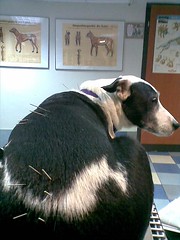
  • 8. Acupuncture can help decrease anxiety especially at night time by treating the yin, kidneys, and heart fire. In addition acupuncture can help with arthritis pain, weakness, and kidney function and help your dog age more gracefully as they get older. I often combine acupuncture with Chinese herbs for these dogs.
  • 8. Reiki can help to relax older dogs and calm anxiety. Reiki is a nice calming way of helping improve health and well being as animals age.
  • 9. Rescue Remedy and other flower essences can help with anxiety and fear. Flower essences are homeopathic in nature and very safe for older animals. Rescue Remedy is the best know but there are many lines for treating a variety of behavior and emotional issues.

    You can dose flower essences by putting 3-4 drops in your dog’s drinking water every time you change their water. It’s ok to use flower essences in the water even if other animals drink from the same dish.

  • 10. Other herbal medications are out there for helping with anxiety in older dogs. I recommend consulting with a holistic veterinary to decide on what is right for your dog.

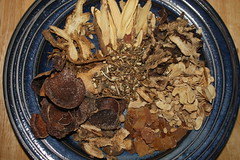
    Many of the most calming herbals like valerian or kava kava can be very dangerous if used incorrectly or in the wrong animal. To use Chinese herbs correctly you should consult with a veterinarian with a background is Chinese herbal medicine or Traditional Chinese Medicine.

  • 10. Western Drugs are always an option. There are may drugs that help with anxiety and can be given if the natural alternatives do not work or are not enough. There are also drugs out there that help with dementia such as Selegiline (Anipryl). Most of the western drugs like the herbs are not cure alls but can help make things better.
  • 11. Some dogs are anxious because they are painful . This is an important thing to rule out before assuming there is a dementia component.

    If your dog is not on pain medication have them evaluated by your veterinarian. If they are on pain medication talk to your vet about increasing the dose or trying something else if there may be a pain factor. Dogs can’t always tell us when they are in pain and pain certainly can cause sleep disturbance and anxiety.

  • 12. Talk to your dog about the change in their position in the house. Many dogs especially the herding breeds take their job of watching the house very seriously. As they get older and can not do it the way they would like to anymore they can become quite anxious. Explaining that your accept them in their old age and making changes to help them, can ease anxiety. See the article Love me for who I am today.
  • 13. Take care of yourself!. This is very important when you are caring for an elderly or sick animal. To be a good caregiver you need to be healthy and well rested.

    If you have a dog that is anxious at night and you are not sleeping consider putting them in a different room than you sleep in, crating them if they are ok with crating, or finding another solution. If you get sick because you are not taking care of yourself you will not be able to care for them.

    It may seem mean to kick them out of your room but it is kinder than letting them sleep with you and being a grumpy caregiver. I had to do this with my old dog Jake and it actually ended up with us both sleeping better. Before we slept in separate rooms, his anxiety made me anxious, which made him more anxious and by the morning we were both a mess.

  • Dementia and anxiety are some of the most frustrating and painful problems I see in older dogs and can be very difficult to deal with. Be gentle on yourself and your dog companion and try to find a healthy way to work with these problems for everyone in the household.

    How do I pick the best food for my dog’s health?

    Saturday, January 23rd, 2010

    Gone are the days when we jumped at the chance to get a three cans for a dollar deal on Alpo at the local grocery store and a bag of Kibbles and Bits. Most dog folks know that feeding good quality food can be one of the most important decisions you can make for your animal friend. These days many people who come to my clinic are already feeding a high quality food.

    So how do you choose?

    While there are no set answers to this question, here are some rules of thumb to follow:

  • 1. Always feed high quality food - So how do I tell what is high quality you ask
    • Make sure meat is the first ingredient and that it is real meat. It should be chicken or turkey or some other recognizable meat (not animal which can be euthanized cats and dogs- yuck!) and it should not be by-product.
    • Make sure there is no corn, corn meal or other corn products. Many animals are allergic to corn and usually only low quality foods have corn. The one exception I can think of to this is that Weruva has a couple foods that have chunks of corn in them. I still think this is a high quality food.
    • Learn how to read labels. You want to see a list of foods you recognize at the top, and then a list of vitamin and minerals you may not, closer to the bottom. Avoid dyes, preservatives like BHA, BHT, and erythoxyquin, food stabilizers like propylene glycol and sugars. For more information on how to read a label see the article What is really in pet food? from Born Free USA.
  • 2. Here is a list of my favorite brands There are other good foods out there to but these are the ones I recommend most often.

    • Weruva This is the only dog food that looks good enough that I would eat it! Made with whole foods and there is no question when you open the can.
    • Wellness is a good solid food with good ingredients. In addition to their traditional and grain free lines, they have a simple ingredient line for dogs with food allergies which is a much better alternative to many of the expensive and low quality prescription diets
    • Homestyle by Prairie, Instinct, Nature’s Variety raw foods are all made by Nature’s Variety. Prairie is their main line, Instinct is grain free and they also make a great raw line I recommend under the Nature’s Variety name. I have been happy with all their foods.
    • Merrick makes a great line of canned and dry foods. I have used their canned line in many inflammatory bowl disease dogs with good success. And they have a very cute marketing campaign.
    • Avoderm and Pinnacle are both solid good natural foods. Avoderm is marketed for animals with itchy skin and can make a difference in dogs with environmental allergies.
    • Orijen and Acana are the best grain free dry foods out there for dogs. If you feed just a dry food or mostly a dry food these would be my top recommendations. They only make dry food but have their own packaging and processing plant for their food which gives them better control on keeping contaminates out of their food lines.
    • Darwin’s Pet is a great northwest company which makes raw diets. If you live in the Seattle area they will deliver to your doorstep. They have a very good quality product and because they are a small company a lot of control on what goes into their food. For raw diets in the Seattle area they are number one
    • Go! and Now! Moderate protein diets with grain free varieties, these two foods are good solid options. Tasty options if the higher protein Orijen doesn’t work and a very good canned option
    • Paw’s Cafe is another great local company in the Seattle area which makes homemade food, raw diets and custom diets. Great folks and very high quality diets. So far they only deliver to the Eastside but there is talk they may come over to Seattle soon. If they do they will be up there with Darwin’s.
    • Update 5/20/10 Because of the recent buyout of Natura pet by Proctor and Gamble I no longer recommend Innova, Evo, California Natural, Karma, or Heathwise.

    I feed multiple brands of food to my own dog and switch flavors and brands daily. If your dog’s stomach allows it I recommend switching brands and varieties of food.

    If I have missed the food you feed your dog add a comment and I will give you my opinion on it.

  • 3. If you have an animal over eight years of age (or a younger geriatric animal) they should not be on an exclusively dry food. Ideally they should have little to no dry food. If your dog loses too much weight on a diet of no dry food try adding in an egg a day and canned sweet potato or pumpkin.

    Dry food can be hard on the kidneys of older animals. Home cooked and high quality canned food are the best option for these guys. Older animals can be on raw food although I rarely recommend switching an older dog to raw late in life if they have been on processed food since puppy hood. If possible find a holistic vet to work with on diet for older dogs or move very slowly as you switch them.

    Dry food is cheapest and some people can not afford to feed anything but it. If dry food is all you can afford, adding a little water, chicken broth, wet food or good quality table scraps will help. There are also some animals that simply do not do well on anything but a dry food or will not eat anything but a dry food. If you feed only a dry diet make sure it is high quality.

    High quality dry food with water or broth is better than low quality wet food.

  • 4. Grain free foods vs foods with grain

    Our dogs should be on a diet with a high protein content and should be eating mostly meat.

    Animals with allergies, cancer, or epilepsy should ideally be on a grain free diet. Many animals with chronic vomiting also do better on a grain free diet or low grain diet.

    Some animals prone to diarrhea do better with a food with some grain.

    Healthy animals can be on a high quality diet with or without grain but if you feed just a dry food I highly recommend it being grain free.

  • 5. So if grain, how much grain?

    There should always be more meat than grain in the food you feed your animal.

    Meat should be the top ingredient but also beware of the multiple names for the same thing. If there are three corn or grain based ingredients right after meat then there is probably more grain in the food. Also stay away from foods with corn and wheat if possible.

    The more whole grain the better. Oats, barley, quinoa, and brown rice are ideal grain sources. Corn, wheat and white rice are not as good.

  • 5. The least processed the food the better (also known as dry vs canned vs raw vs cooked)

    In the ideal world we would all have time to come home each day and cook for ourselves and our pets. However many people don’t have time to cook for themselves or their dogs.

    If you have the time and/or money start your dog on a raw diet or cook for them at home. There are also companies like Paw’s Cafe which make homemade dog food. If you are against feeding raw food or your dog doesn’t tolerate it, raw foods can also be cooked. Crock pots and steamers are ideal for this. Although you can always throw it in a frying pan.

    If you feed a raw diet make sure it is a frozen commercial product or that you freeze the meat or the food before you feed it to kill of any parasites that may be in the food. Pork and fish should never be fed raw to dogs.

    In general the less proceeded the food the better. With raw being on the top, followed by cooked, canned and finally dry. But do what works for your household.

    There are almost no overweight dogs on raw diets. If your dog is overweight get them off the dry food.

    My own dog, who is a cancer survivor, eats high quality canned food. He doesn’t tolerate raw and I don’t have time to cook for him. We found that he also needed some grain to keep his digestion healthy.

    While I have a number of animals on homemade or raw diets, many of my clients feed their dogs a mixture of high quality dry and wet because of convenience and cost.

  • 6. Pick the meat which is best for your cat or dog. If possible rotate meat sources.

    If your animal has obvious allergies then this choice is made for you. If not, I am highly in favor of switching protein sources routinely. This reduces your animals chance of developing allergies and adds some variety to your their diet. Imagine if you had to eat the same thing over and over again. Boring!

    Chinese medicine also has an energetic system for working with food. See my article The dance of life and the energetics of food for more information.

    I do not recommend feeding pork to dogs because of the way pigs are raised and the energetics that go along with that. Pork must never be eaten raw because of the diseases that pigs carry.

  • 7. Table scraps are ok

    No really, I know we as a veterinary community have told you they aren’t. But if you eat healthy food it is fine for your dog to have some. Just remember - no grapes, no raisins, no onions, no chocolate.

  • 8. For animals in kidney failure, the quality of the protein is much more important than the amount of protein.

    For years the veterinary community has recommended low protein for dogs in kidney failure. The new studies out however show that diets moderate in very high quality protein are best for these animals.

    Avoid the low quality, low protein prescription kidney diets and feed a canned or whole cooked food diet with moderate protein and some grain or potato instead. Try your best to not feed dry food to these guys.

  • 9. Do what is best for your dog and you.

    If all the diets I recommend give your dog diarrhea, find something else to feed. If you can’t feed a raw diet it’s ok. If you don’t have time to cook, well you’re just like me. These are recommendations, not rules that are set in stone.

    Do the best you can and try to have fun with it! After all you know your dog better than anyone else!

  • Helpful links
    Dog Aware’s dog food page More information than you could ever use about dog food!.
    Born Free’s What’s Really In Pet Food A great article about pet food companies and processing.

    Books about dog food and diet
    Dr. Pitcairn’s New Complete Guide to Natural Health for Dogs and Cats
    The Whole Pet Diet: Eight Weeks to Great Health for Dogs and Cats
    The Healthy Dog Cookbook: 50 Nutritious & Delicious Recipes Your Dog Will Love

    Food Pets Die For: Shocking Facts About Pet Food
    Not Fit for a Dog!: The Truth About Manufactured Dog and Cat Food
    Home-Prepared Dog & Cat Diets: the Healthful Alternative

    Also see How do I pick the best food for my cat’s health?.

    Just a dog

    Wednesday, January 6th, 2010

    From time to time, people tell me, “lighten up, it’s just a dog,” or, “that’s a lot of money for just a dog.” They don’t understand the distance traveled, the time spent, or the costs involved for “just a dog.”

    Some of my proudest moments have come about with “just a dog.” Many hours have passed and my only company was “just a dog,” but I did not once feel slighted.

    Some of my saddest moments have been brought about by “just a dog,” and in those days of darkness, the gentle touch of “just a dog” gave me comfort and reason to overcome the day.

    If you, too, think it’s “just a dog,” then you will probably understand phases like “just a friend,” “just a sunrise,” or “just a promise.”

    “Just a dog” brings into my life the very essence of friendship, trust, and pure unbridled joy. “Just a dog” brings out the compassion and patience that make me a better person.

    Because of “just a dog” I will rise early, take long walks and look longingly to the future. So for me and folks like me, it’s not “just a dog” but an embodiment of all the hopes and dreams of the future, the fond memories of the past, and the pure joy of the moment.

    “Just a dog” brings out what’s good in me and diverts my thoughts away from myself and the worries of the day. I hope that someday they can understand that it’s not “just a dog” but the thing that gives me humanity and keeps me from being “just a man.”

    So the next time you hear the phrase “just a dog.” just smile, because they “just don’t understand.

    -Richard Biby

    Thanks to a forum poster on the West Seattle Blog for this wonderful quote.

    Christmas is coming!

    Saturday, December 19th, 2009

    Send me your favorite animal photos and I will post them here. lena@pathwithpaws.com


    More wonderful books

    Tuesday, December 15th, 2009

    With the holidays coming up I wanted to add a few more of my all time favorite books!

    Animal Dreams

    My favorite book, Animal Dreams, is the story of Codi Noline who returns to her home town after a string of failures and finds what it truly means to belong. Through an environmental catastrophe, caring for her dying father, and falling in love Codi is able to see that success is not always about degrees and money but more about how you look at life.

    Animals dream about the things they do in the daytime, just like people do. If you want sweet dreams, you’ve got to live a sweet life.

    I highly recommend this book! Did I mention it has one of the sweetest old dogs in literature?

    The Color of Distance

    A close second to Animal Dreams, The Color of Distance is about a young scientist, Juna, who is left on a distant planet by mistake. She is saved by a race of beings with incredible healing powers, the Tendu. This is an amazing book about healing, love, and how differences between us, no matter what species we are, can be bridged.

    My favorite parts of this book are the rich healing experiences that Juna learns and shares not just for the creatures in this world but also for their planet and the balance that is held between all living things.

    While not directly about dogs or cats, this book very much touched my heart as someone who lives with companion animals.

    Although out of print you can still easily find this book used.

    Carl’s Christmas
    Who couldn’t love Carl’s Christmas? From the Good Dog Carl books comes the tale of Carl’s Christmas night of babysitting. Who wouldn’t trust their baby with a Rottweiler like Carl? Although without words, the illustrations of this book tell this colorful tale well.

    Also see Holiday Books for Cat Lovers

    My animal companion has to go under anesthesia - what can I do to help?

    Tuesday, November 24th, 2009

    If we are lucky our animal friends only have to go through surgery once, when they are spayed or neutered. However many animals do need to be under anethesia other times either for a dental cleaning, to get sutures, or to have surgery. Whatever the reason, surgery and anethesia are hard on our animal friends. But there are things you can do to help them recover faster and more comfortably.

    As always, check with your veterinarian on any supplements you use.

  • 1. Arnica
    Arnica is a homeopathic remedy which helps with bruising and trauma. Over the years I have been amazed and impressed at how much difference this very safe remedy can make in healing. I have seen incisions heal in half the time and dogs have very little bruising and swelling in situations you would normally expect to see it.

    I always recommend Arnica for all my animal patients who have to undergo surgery or any other procedure that there will be tissue or bone trauma. Because it is a homeopathic remedy it is very safe ever for old and debilitated animals.

    I use the Arnica 30c pellets and dose them at 2-3 pellets (usually 2 for cats/small dogs and 3 for dogs) the morning of surgery, the evening after surgery, and then three times a day for three days. Because the pellets are so small they can safely be given the morning of surgery.

    Arnica can be bought at most health and supplement stores or by clicking on Arnica.

  • 2. Acupuncture
    I highly recommend an acupuncture treatment right after surgery or anesthesia. Acupuncture can help with clearing anesthesia from an animal’s system and decrease the chance of them having a hard recovery. Acupuncture can also help ease pain and speed healing.

    If possible acupuncture can be performed the day of surgery after an animal has woken up. Many times this is not possible because of the hours acupuncturists work and I end up treating most animals the day after surgery.

    Acupuncture can also help dogs who have had bad recoveries to anesthesia in the past and and make it possible to perform dentals or surgeries on these sensitive animals.

  • 3.Yunnan Baiyao
    While I don’t recommend Yunnan Baiyao (also called Yunnan Paiyao) for all animals undergoing surgery or anethesia, it is still one of my most important herbal formulas. I mainly use it in any procedure or surgery where there is a concern about bleeding. This includes many tumor removal and abdominal surgeries. I have seen this wonderful herbal formula save animal’s lives before.

    Please see my article, A Magic Vial of Yunnan Baiyao and the wikipedia article.

    I usually dose Yunnan Baiyao at one capsule twice a day for a few days before and after surgery for your average sized dog. Cats and small dogs, I use the powder and put about a 1/8 of a teaspoon in their food twice a day.

    Yunnan Baiyao can be bought in most international districts and by clicking on Yunnan Baiyao above.

  • 4.Reiki
    If one of my animals need to undergo surgery I always give them a reiki session before to get them into a good place for surgery. I usually work with a local practitioner, Rose DeDan, who also does animal communication. She is able to help explain what is going to happen and put their body in the best possible place for surgery and/or anesthesia.
  • 5.Pain medication
    Enough can not be said about pain medication. Make sure your veterinarian gives your animal pain medication before surgery and sends you home with something you can give at home. Nothing is worse then seeing our animals in pain and not being able to do anything about it. Routine dentals do not usually need pain meds.
  • 6. Companionship and love!
    You are the safest person to your animal. They want to be with you after surgery and they want to feel loved and cared for. If possible consider taking a day off work after their surgery or plan your animal’s surgery or procedure on a Friday.
  • 7. Somewhere healing to recover
    It is so important to have somewhere safe, quiet, warm and soft to recover after surgery. Anesthesia can make the senses more sensitive and many animals get headaches coming out of surgery. Often times the drugs used also make our animal friends disoriented. Make sure that there is no access to stairs and nothing to fall off of. Keeping lights dim and sound to a minimum also helps. Sometimes classical music played softly will help relax our friends.
  • I hope these simple suggestions are helpful! I know they have helped many of the animals I work with and my own beloved animal companions.

    The Dance of Life and the Energetics of Food

    Monday, November 23rd, 2009

    Rose DeDan, a local shaman and healer, wrote a wonderful article today on her blog, The Dance of Life, The endless cycle of birth, death and our relationship to the food we consume. It give new meaning to the saying “you are what you eat.” She talks about the energetics of our food and how the way animals are raised can affect our health. We are all energetic beings and just as we take on the energy of those around us, we can also take on the energy of the animals we consume. If they have been treated well and fairly we end up with nutritious food, if they have not been it can lead to many health problems for us.

    The Chinese take this one step further. They also look at the normal energetic characteristics of the animals we eat in determining a proper diet. Many of my clients who have asked about diet for their animals have seen this in action. For example for a flighty nervous dog I would never suggest rabbit or deer because both are nervous animals. An anxious dog would do best on beef or bison which are both large and grounded creatures. On the flip side a very sluggish dog may do better on something light and energetic like a deer or rabbit.

    Food also has a temperature and other characteristics in Chinese Medicine. Trout is the hottest meat and a dog who is always cold would do well on it. Seaweed and Cucumber are considered cold and can cool a dog with excess heat. Sweet potato and pumpkin are sweet and help with digestion. Beef is good at tonifying the blood and helping with weakness. Carrots and other root vegetables are very grounding and help an animal be more connected to the earth.

    There are many great books on this subject!

    For further reading

    My favorite book on this subject (although written for people) Prince Wen Hui’s Cook: Chinese Dietary Therapy

    Another good book although with more information then the average person needs Healing with Whole Foods: Asian Traditions and Modern Nutrition

    One of my favorite books on Chinese Medicine with a great food section in back Between Heaven and Earth: A Guide to Chinese Medicine

    Introduction to Tellington TTouch Class offered in West Seattle

    Thursday, November 19th, 2009

    From Rose DeDan -

    I became interested in Tellington TTouch, a long time ago, but that interest kind of got sidelined while focusing on my shamanic training.

    Recently I read some very impressive stories by a long-time animal communicator that fanned that interest back into action, especially since I have wanted some additional assistance for Puma, my wonderful dog companion, as he enters his senior years. And lo, and behold, Shannon Finch’s name crossed my path. So, Wild Reiki and Shamanic Healing is now hosting a TTouch class in Seattle for the very first time! (And I believe there will be a live demo with said dog, and perhaps one of my cats who is shy of being handled – I may borrow a video camera for that!)

    • Do you have a shy or aggressive dog?
    • A cat who is getting along in years?
    • A bird who squawks incessently?
    • Are you interested in enhancing the bond with your animals?

    Then this hands-on workshop is for you.

    For more information on TTouch see What is TTouch?

    When: Saturday, December 5, 2009, 9:30am-12:30pm
    Where: Wild Reiki and Shamanic Healing Office, Alki (directions sent at time of registration)

    You’ll learn how to improve your animal’s health and wellbeing with several TTouch techniques
    that release the tension, fear and anxiety that lead to behavior problems.

    You’ll learn how to ease the ailments associated with aging as well as first aid measures that can
    save your animal’s life.

    And while TTouch can assist the healing of injuries and illness, and help change undesirable behaviors, it also builds a deeper rapport between humans and animals, so your critter doesn’t have to have a problem in order to benefit from this class.

    Please do not bring your animal to the workshop, we’ll be practicing on willing stuffies (stuffed animals) this time around!

    Registration: Fee $95/person. Class size is limited to a small number of participants. Call Rose De Dan at 206-933-7877 or email her at wildkingdomreiki (at) earthlink (dot) net for more information or to register.

    TEACHER BIO
    Shannon Finch is owner of The AnimalKind Company in Stanwood, focusing on positive training for all species. She is a certified Tellington Touch practitioner for both companion animals and horses. She has worked with of animals of many species, from dogs, cats, and horses, to birds, reptiles, rabbits and pocket pets, and even farm critters such as cows, goats, and chickens.

    Shannon has taught TTouch all over the west, including Best Friends Animal Sanctuary and the Hawaii Humane Society, has given presentations for numerous local animal welfare groups, including PAWS, the Alternative Humane Society of Bellingham, Hooterville, (now Homeward Bound), Canines for Citizens’ Independence, Pasado’s Safe Haven, Purrfect Pals, Skagit Humane Society, and the Monroe Pet Expo. She’s also taught animal behavior and TTouch classes for Everett Community College. She is currently working on her thesis for a Master’s Degree in Humane Education.

    Canine influenza is not swine flu but should I vaccinate for it?

    Thursday, November 12th, 2009

    With all the talk of H1N1 in the news, I have started to get some questions on the canine influenza virus also known as N3H8 virus. And this year because a new vaccine for canine influenza came out, many of the questions are about if vaccination is important.

    So what is my overall recommendation.

    Don’t vaccinate for it

    So from the beginning - here is what we know

    • This virus has been around since at least 2004 and probably since as early as 1999 but was originally thought to be a problem in greyhounds only.
    • At first there was a lot of fear because greyhounds can get a hemorrhagic symptom from this virus that involves bleeding into their lungs and often times death. We have since found out that this virus does not cause that problem in other breeds.
    • Most canine influenza presents as a mild kennel cough with a mild fever. A full 20-25% of dogs with canine influenza do not show any symptoms at all. Some dogs do get very sick with canine influenza and a very small percentage die of secondary lung infections. From my research it seems that canine influenza is no more of a problem then kennel cough and most dogs recover with no medical intervention. Occasionally antibiotics are needed.
    • Canine influenza is not causally passed. It usually takes 3-4 days of exposure with an infected dog for a dog to catch it. This is most likely in boarding and shelter situations.
    • Earlier this year a new vaccine for canine influenza was released on a conditional license. What this means is the USDA allowed release of this vaccine without as much testing as is normally needed to release a vaccine. While the minimal drug company studies showed that this vaccine is safe, there is no long term data on how safe this vaccine is in the long run or how effective it is.
    • From my experience, most vaccine side effects in dogs are not immediately observed.
    • The vaccine also doesn’t prevent infection with or shedding of the influenza virus (same as the vaccines for H1N1), but rather decreases the symptoms of the disease.

    So we have a vaccine which we do not know much about and like most vaccines probably has side effects, which doesn’t prevent infection or transmission of influenza, for a disease that is not deadly in most dogs. Hmm…. Once again doesn’t sound so good to me.

    To me the benefits of this vaccine do not outweigh the possible risks. If you haven’t read my article on dog vaccination I recommend it. I have seen more dogs suffer from vaccine side effects in my practice then I have seen dogs vaccinated with a minimal core protocol (as I recommend) come down with infectious disease.

    What is worrisome is that many boarding kennels and groomers are requiring this vaccine. I believe that this vaccine should be a choice between a dog’s person and their veterinarian. I also think most boarding kennels do not realize that this vaccine does not prevent disease.

    For further reading here are some good resources on canine influenza -

    The Center for Food Safety and Public Health of Iowa State University

    Ten thing to know about the H3N8 dog flu from the New York Times