Posts Tagged ‘acupuncture’

Dementia and anxiety in your older dog - What you can do.

Monday, February 1st, 2010

It is sad to see our beloved animal companions get old and even harder to see them start to loss their mind. In many dogs the first sign of this is anxiety in the evening or throughout the night, although dementia or cognitive dysfunction syndrome can manifest in many different ways.

Not all dementia has an anxiety component to it and not all anxiety in older dogs is from dementia but the two often go together.

So what causes dementia in older dogs?

There are four main causes of dementia or cognitive dysfunction syndrome.

  • 1. Free radical formation Free radicals harm healthy cells in the brain.
  • 2. Hypoxia to the brain In other words there is not enough blood getting to the brain.
  • 3. Alterations in neurotransmitters There is too much or not enough of certain necessary neurotransmitters in the brain. You need neurotransmitters to have your neurons or brain cells function together.
  • 4.Neural infiltrates such as B amyloid and lipofusion These infiltrates destroy healthy brain tissue, similar to alzheimer’s disease in people.
  • In Traditional Chinese medicine (or TCM), anxiety in older animals is caused by too much heart fire related to the kidneys becoming deficient as your dog ages. Kidneys are considered to be the water element and as we age the kidneys get deficient and water in the body system decreases to a point that it allows heart which is a fire element to flare too much and cause anxiety especially during the heart peak hours of 11pm - 1am.

    According to TCM, another issue is that older animals can become what is called yin deficient. Yin holds the yang at night so we can sleep. If there is not enough yin, the yang is not held and sleep doesn’t happen.

    Sometimes these problems are reversible but even when they are not, there are things you can do to help prevent the problem from getting worse and help with symptoms.

    Here is a list of some things that can help your older dog with dementia or anxiety. Please check with your veterinarian to come up with a plan that is safe for your dog.

  • 1. Walking is the most important thing you can do for your older dog. Walking just ten minutes twice a day can significantly increase brain blood flow and reverse symptoms of dementia from hypoxia. Plus it can help prevent muscle atrophy and help with arthritis.
  • 2. Ginkgo does three important things. It helps increase blood flow to the brain by vasodilation , it helps regulate dopamine in the brain and it helps prevent amyloid deposits. I dose ginkgo at 100mg per 50lb of dog.
  • 3. Fish Oil and other antioxidants help prevent and repair free radical damage and stimulate brain function. In addition Fish Oil also help with arthritis and dry coat problems in older dogs. I dose Fish Oil at 500mg per 40 lb of dog. Extra vitamin B and E can also help these dogs.
  • 4. SamE helps increase dopamine function in the brain, stimulates brain function and works as an antioxidant. It also helps with joint pain and liver function which many older dogs have problems with. I dose SamE at 500mg per 50lb of dog.
  • 4. Remove any compact fluorescent or fluorescent lighting. Fluorescent lighting can cause a high pitched hum that humans can not hear but dogs and cats can. Older dogs loss their high frequency hearing last so even almost deaf dogs can still hear very high frequency noises. In addition fluorescent lighting can affect brain function and can cause headaches. See The danger of compact fluorescent lighting.
  • 5. Get rid of the dry food. Many older dogs do better on home cooked food or canned food. I don’t recommend switching an old dog to raw food if they have not been on it before. From a Chinese medicine view, dry food is too processed and dry for an older dog who already is kidney deficient.
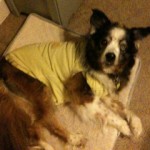
  • Oneof my patients, Luna wearing a T shirt

    One of my patients, Luna wearing a T shirt

  • 5.Wearing a T-shirt, Thundershirt, or Anxiety Wrap can help your older dog if they have problems with anxiety. It sounds weird I know, but it actually does work.

    It is based around the ideas from Tellington TTouch of using an ace bandage. See the article Put an ace bandage on my dog?. Wearing the shirt enhances your dog’s sense of their own body and makes them feel more confident in their movements and behavior. You can use a snug fitting human T-shirt, a Thundershirt, or an anxiety wrap. I have found however that if your dog has a lot of arthritic pain the anxiety wrap is too hard to put on, so try the Thundershirt or a T-shirt in that case. This is also an idea that can work in young dogs with anxiety.

  • 6. Melatonin can help old dogs sleep at night. Sometimes older dogs can get confused between night and day and end up sleeping all day and then pacing and panting at night. This can make it very hard for us humans to sleep also. Giving Melatonin in the evening can help regulate night and day for these guys and get everyone a better night’s sleep. I dose Melatonin at 3-4mg per 50lb of dog.
  • 7. Small meals more often and right before bed are sometimes better for these older dogs. A small meal of wet or cooked food right before bedtime can help get these dogs through the night and help them sleep better.
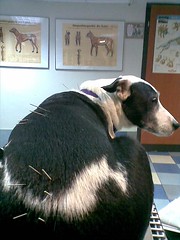
  • 8. Acupuncture can help decrease anxiety especially at night time by treating the yin, kidneys, and heart fire. In addition acupuncture can help with arthritis pain, weakness, and kidney function and help your dog age more gracefully as they get older. I often combine acupuncture with Chinese herbs for these dogs.
  • 8. Reiki can help to relax older dogs and calm anxiety. Reiki is a nice calming way of helping improve health and well being as animals age.
  • 9. Rescue Remedy and other flower essences can help with anxiety and fear. Flower essences are homeopathic in nature and very safe for older animals. Rescue Remedy is the best know but there are many lines for treating a variety of behavior and emotional issues.

    You can dose flower essences by putting 3-4 drops in your dog’s drinking water every time you change their water. It’s ok to use flower essences in the water even if other animals drink from the same dish.

  • 10. Other herbal medications are out there for helping with anxiety in older dogs. I recommend consulting with a holistic veterinary to decide on what is right for your dog.

    Many of the most calming herbals like valerian or kava kava can be very dangerous if used incorrectly or in the wrong animal. To use Chinese herbs correctly you should consult with a veterinarian with a background is Chinese herbal medicine or Traditional Chinese Medicine.

  • 10. Western Drugs are always an option. There are may drugs that help with anxiety and can be given if the natural alternatives do not work or are not enough. There are also drugs out there that help with dementia such as Selegiline (Anipryl). Most of the western drugs like the herbs are not cure alls but can help make things better.
  • 11. Some dogs are anxious because they are painful . This is an important thing to rule out before assuming there is a dementia component.

    If your dog is not on pain medication have them evaluated by your veterinarian. If they are on pain medication talk to your vet about increasing the dose or trying something else if there may be a pain factor. Dogs can’t always tell us when they are in pain and pain certainly can cause sleep disturbance and anxiety.

  • 12. Talk to your dog about the change in their position in the house. Many dogs especially the herding breeds take their job of watching the house very seriously. As they get older and can not do it the way they would like to anymore they can become quite anxious. Explaining that your accept them in their old age and making changes to help them, can ease anxiety. See the article Love me for who I am today.
  • 13. Take care of yourself!. This is very important when you are caring for an elderly or sick animal. To be a good caregiver you need to be healthy and well rested.

    If you have a dog that is anxious at night and you are not sleeping consider putting them in a different room than you sleep in, crating them if they are ok with crating, or finding another solution. If you get sick because you are not taking care of yourself you will not be able to care for them.

    It may seem mean to kick them out of your room but it is kinder than letting them sleep with you and being a grumpy caregiver. I had to do this with my old dog Jake and it actually ended up with us both sleeping better. Before we slept in separate rooms, his anxiety made me anxious, which made him more anxious and by the morning we were both a mess.

  • Dementia and anxiety are some of the most frustrating and painful problems I see in older dogs and can be very difficult to deal with. Be gentle on yourself and your dog companion and try to find a healthy way to work with these problems for everyone in the household.

    My animal companion has to go under anesthesia - what can I do to help?

    Tuesday, November 24th, 2009

    If we are lucky our animal friends only have to go through surgery once, when they are spayed or neutered. However many animals do need to be under anethesia other times either for a dental cleaning, to get sutures, or to have surgery. Whatever the reason, surgery and anethesia are hard on our animal friends. But there are things you can do to help them recover faster and more comfortably.

    As always, check with your veterinarian on any supplements you use.

  • 1. Arnica
    Arnica is a homeopathic remedy which helps with bruising and trauma. Over the years I have been amazed and impressed at how much difference this very safe remedy can make in healing. I have seen incisions heal in half the time and dogs have very little bruising and swelling in situations you would normally expect to see it.

    I always recommend Arnica for all my animal patients who have to undergo surgery or any other procedure that there will be tissue or bone trauma. Because it is a homeopathic remedy it is very safe ever for old and debilitated animals.

    I use the Arnica 30c pellets and dose them at 2-3 pellets (usually 2 for cats/small dogs and 3 for dogs) the morning of surgery, the evening after surgery, and then three times a day for three days. Because the pellets are so small they can safely be given the morning of surgery.

    Arnica can be bought at most health and supplement stores or by clicking on Arnica.

  • 2. Acupuncture
    I highly recommend an acupuncture treatment right after surgery or anesthesia. Acupuncture can help with clearing anesthesia from an animal’s system and decrease the chance of them having a hard recovery. Acupuncture can also help ease pain and speed healing.

    If possible acupuncture can be performed the day of surgery after an animal has woken up. Many times this is not possible because of the hours acupuncturists work and I end up treating most animals the day after surgery.

    Acupuncture can also help dogs who have had bad recoveries to anesthesia in the past and and make it possible to perform dentals or surgeries on these sensitive animals.

  • 3.Yunnan Baiyao
    While I don’t recommend Yunnan Baiyao (also called Yunnan Paiyao) for all animals undergoing surgery or anethesia, it is still one of my most important herbal formulas. I mainly use it in any procedure or surgery where there is a concern about bleeding. This includes many tumor removal and abdominal surgeries. I have seen this wonderful herbal formula save animal’s lives before.

    Please see my article, A Magic Vial of Yunnan Baiyao and the wikipedia article.

    I usually dose Yunnan Baiyao at one capsule twice a day for a few days before and after surgery for your average sized dog. Cats and small dogs, I use the powder and put about a 1/8 of a teaspoon in their food twice a day.

    Yunnan Baiyao can be bought in most international districts and by clicking on Yunnan Baiyao above.

  • 4.Reiki
    If one of my animals need to undergo surgery I always give them a reiki session before to get them into a good place for surgery. I usually work with a local practitioner, Rose DeDan, who also does animal communication. She is able to help explain what is going to happen and put their body in the best possible place for surgery and/or anesthesia.
  • 5.Pain medication
    Enough can not be said about pain medication. Make sure your veterinarian gives your animal pain medication before surgery and sends you home with something you can give at home. Nothing is worse then seeing our animals in pain and not being able to do anything about it. Routine dentals do not usually need pain meds.
  • 6. Companionship and love!
    You are the safest person to your animal. They want to be with you after surgery and they want to feel loved and cared for. If possible consider taking a day off work after their surgery or plan your animal’s surgery or procedure on a Friday.
  • 7. Somewhere healing to recover
    It is so important to have somewhere safe, quiet, warm and soft to recover after surgery. Anesthesia can make the senses more sensitive and many animals get headaches coming out of surgery. Often times the drugs used also make our animal friends disoriented. Make sure that there is no access to stairs and nothing to fall off of. Keeping lights dim and sound to a minimum also helps. Sometimes classical music played softly will help relax our friends.
  • I hope these simple suggestions are helpful! I know they have helped many of the animals I work with and my own beloved animal companions.

    The mysteries of nerves - paralysis, seizures and old age neurologic conditions Part 1 paralysis

    Friday, May 1st, 2009

    Did you know that one out of seven dachshunds will become paralyzed in their lifetime? That many older dogs and cats suffer from strokes and vestibular disease in their old age? That seizures are so common in some breeds that they can affect 15-20% of the breed?

    Neurologic problems are quite common in our companion animals and are some of the most expensive and frustrating problems to deal with. Often times the only way to diagnose these problems is with a MRI, which can cost $1000 and requires your animal to be under anesthesia. Many times in older animals the risk of anesthesia to too great and these problems go undiagnosed.

    I am often surprised that veterinarians do not offer alternative options for working with these neurologic problems. Many times the only things western medicine can offer are expensive surgeries, a lifetime of drugs, or steroids with their many side effects.

    For example, traditionally a course of treatment for paralysis, back pain or paresis in a dachshund would include steroids, months of cage only confinement and possibly an expensive surgery. While surgery is a good option in some cases, especially if there is no deep pain, it has it’s own set of risks including that sometimes it does not solve the problem and can actually make things worse.

    But there are other options out there!

    Let’s talk about the dachshunds first! I love working with dachshunds!

    They are some of the best responders to acupuncture out there. In fact I have never worked with a dachshund who did not respond to acupuncture. And they really seem to understand that you are helping them. I have been able to work with dachshunds who were completely paralyzed and with acupuncture and herbs have had them back to walking in as little as three acupuncture treatments! Wow!

    OK just to be realistic, most take longer than that but the majority can be gotten back on there feet as long as they still have deep pain. Meaning that if you squeeze a back toe really hard with a surgical hemostat they can feel it. On average I would say it takes four to six months of weekly treatments.

    Of course it’s not all dachshunds and I have worked with other animals with paralysis including cats and all breeds of dogs. Of these others, I would say about 90% have had a positive response. That’s still pretty good!

    Even better is if I can get these animals with paralysis to hydrotherapy. Swimming helps keep the muscles working well while we are getting the nerves to work again and helps keep the muscle mass from wasting away. Dachshunds and other dogs can be amazing little swimmers and it gives these animals a way to move on there own if they can’t support their weight on land.

    Unfortunately for cats this is not an option as you can well imagine!

    I often work with Wellsprings in Seattle, Washington but there are more and more hydrotherapy clinics opening up around the world.

    I can’t tell you how rewarding it is to be able to work with these amazing creatures to help their body to heal and to see them be able to walk again.

    Here are some wonderful resources on disabled pets

    • Handicapped Pets is a great site for disabled pet supplies and runs the best forums for people with special needs animals. I have had some time to hang out and participate on these forums and these folks not only are super educated on the options out there for working with these animals but have amazing stories about their own very loved handicapped companions. It is a great place to go for education and for support from others going through the same thing.
    • One of the dogs I treat has his own blog. Buddy’s blog is a great place to check out the story of a very cool little dachshund and one of my favorite patients.

    Soon to come neurologic problems in older animals and seizure disorder.

    Stop the pain! Arthritis and your animal friend - part 1 alternative medicine options

    Wednesday, March 18th, 2009

    It’s sad to see our animal companions no longer be able to do the things they once could do as they age and grow older. All older animals have some amount of arthritis although some have many more problems with it. Western medicine has very few options for treating arthritis and uses mostly drugs, to cover the pain. Many times animals are on three different drugs and it still isn’t enough.

    In some animals arthritis manifests as weakness caused by the inflammation pushes on the nerves. Many dogs walk around like their feet are asleep, tripping over things, stumbling and no longer having the strength to jump into the car or onto the bed. Unfortunately because they can no longer walk as far or do as much as they used to, their muscles start to atrophy or waste away, causing a vicious cycle. As the weakness increased, they do less, which causes more atrophy from disuse, leading to more weakness and more atrophy and less activity. In the end many of these animals can no longer get up on their own or even take a short walk.

    In other animals arthritis will manifest as pain, which can also prevent movement and cause the weakness/atrophy cycle. Many of these animals will become moody and withdrawn and may even snap and bite at their people out of fear of pain. It is so hard to see our friends have so much pain that they no longer want our affection.

    In most animals there is a combination of pain and weakness.

    Usually dogs suffer more than cats because they carry more weight and are used to daily activity. Also people often don’t notice that their cats are painful because they spend so much time sitting and sleeping

    So what do we do for our friends to help them live out their old years happy and pain free?

    • Acupuncture Being an acupuncturist, I always recommend acupuncture first. Of course this is also because I have seen how well it works in the animals I treat. I often find that if I can work with animals when they first have problems, they do so well we only need to treat them every one to three months. Unfortunately most of the animals I see have had problems for a while and their people only learned about acupuncture when they had tried everything that western medicine had to offer. In these animals acupuncture can still work and work well but usually treatments need to be closer together.

      It is so nice to see these animals happy and able to enjoy life again!

    • Hydrotherapy is a great option especially in dogs who have muscle atrophy. Unfortunately it cannot be done with cats although Sheila Wells at Wellspings has told me they have worked with rabbits before. Hydrotherapy is done in a small swimming pool and involves massage and physical therapy in the water. I have seen excellent results with hydrotherapy especially combined with acupuncture. Hydrotherapy helps to rebuild muscles, increase range of motion and work out sore and sensitive areas of the body without the impact on the body of exercise on land. My favorite pool is Wellsprings in Seattle Washington. They have a great website with lots of information and photos that I love to refer people to. Click on the link to check it out!
    • herbs5

    • Herbs
      I have worked with Chinese herbs with many of these arthritic dogs and some cats. The combination of acupuncture and herbs usually helps with pain and movement and helps animals maintain between treatments. Some animals do not do well on Chinese herbs and it is important to work with an herbal practitioner to find the right combination to help your particular animals. I rarely use Chinese herbs in cats because they are very sensitive to them. There are also commercial products available, my favorite is Dog Gone Pain
    • Fish oil/ Omega oils
      The Omega 3 Fatty Acids in fish and cod liver oil actually helps decrease arthritic inflammation in dogs (not true for cats although it helps with other things). Adding a little fish oil to the diet can help many animals.
    • Glucosamine/MSM/chondroitin
      These supplements help to decrease inflammation and rebuild damaged cartilage. They are often sold in combination. The nice thing about these supplements is that they have few side effects and are very safe. Some animals have a wonderful response to them and some have almost no response. It usually takes a month to six weeks to see if your animal will have a positive response. Adequan, similar to glucosamine is also available in an injectable form and works better in some animals. It is also a lot easier to give to cats who are hard to medicate daily. After the initial series of injections it usually only needs to be given once a month.
    • Chiropractics
      Many animals have subluxations of their spine especially as they age. A good chiropractor can often help with mobility and pain. I have found that chiropractic adjustments work best in animals with a very tight back and more pain then weakness. For my own cat, chiropractic adjustments have worked better than anything else we have tried and have made his life much better. Make sure you find a chiropractor who is used to working with animals and knows animal anatomy.

    • Massage/Acupressure
      Massage can help to loosen tight muscles and increase blood circulation. It also can help with pain.We know it works for us, why not for our animal friends. Once again make sure you find a massage practitioner who is certified to work with animals.

      Acupressure works with the acupuncture points and helps decrease pain and relax muscles.

      There are many great books on acupressure and massage for animals. Here are a few
      The Well-Connected Dog: A Guide to Canine Acupressure
      Acu-Cat: A Guide to Feline Acupressure
      The Healing Touch for Dogs: The Proven Massage Program for Dogs, Revised Edition
      The Healing Touch for Cats: The Proven Massage Program for Cats, Revised Edition
      Four Paws Five Directions: A Guide to Chinese Medicine for Cats and Dogs

    • Reiki/Bowen/Polarity/Craniosacral and other energy therapies These therapies help stimulate the body to heal and can decrease pain and improve quality of life. Since there is little regulation of these therapies it is important to get a referral before seeing someone. This is especially true of Reiki since there are so many people who practice it. A good practitioner can make a huge difference in an animal’s quality of life.

    It is better to do one thing and stick with it than to jump around between therapies. Often times animals will began with me doing acupuncture and herbs and then we will add in other therapies as needed. If I can’t help an animal with acupuncture I will refer them to another practitioner to try something else. Don’t make too many changes all at once in an old animal’s life. Go slowly instead.

    Coming soon - Comparing the western arthritis drugs

    Basil gets his acupuncture among friends

    Friday, March 6th, 2009

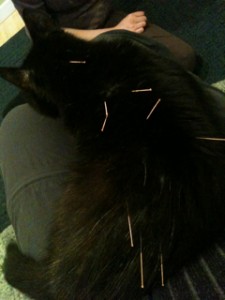
    acubasil1

    For anyone who ever asked,” how do you do acupuncture on a cat?”

    Here is a good book on Chinese Medicine and acupuncture/acupressure for cats and dogs
    Four Paws Five Directions: A Guide to Chinese Medicine for Cats and Dogs

    My vet can no longer help! Who do I turn to now?

    Wednesday, March 4th, 2009

    How do you decide where to turn when western medicine has run out of options? Almost everything available for humans is now available for animals but how do you decide between all the options. There are chiropractors, acupuncturists, reiki practitioners, homeopathic veterinarians, nutritional consultants, hydrotherapy specialists, massage practitioners, and many other options. If you read the internet there are hundreds of supplements made especially for animals and many sound like they work miracles.

    Here are a few tips -

  • 1. Get a referral from someone you trust if you can. Many veterinarians will now refer to alternative practitioners. We don’t take their business and we send back happy clients. If your veterinarian cannot offer a referral check with your local pet food store, especially the neighborhood ones, they often have a list of referrals. They also work with animal people all day long so they know the word on the street on who and what has helped. There are also online referral sites such as IVAS and Animal Wellness Network and many sites with reviews of clinics, such as Yelp.
  • 2. If you are exploring the internet for products online check out the forums, such as Handicappedpets.com, catster, and dogster, for suggestions. The companies selling the products will always give you glowing reviews. It is safer to listen to people who have actually used the product. A good veterinarian will also be able to help you determine if a product will help and if it is dangerous for your animal. Always check the safety of a product, especially if your animal is old, sick, or on other medication before using it.
  • 3. Only try one thing at a time and stick with it for at least a month. It is better to do one thing consistently then to jump around. Most natural therapies take time to work. Sometimes If your animal is extremely sick or has cancer you will need to make many changes at once. If you need to do this then working with a veterinary practitioner is highly recommended.
  • Because I practice acupuncture I often recommend it to start because I have seen how well it can work. Often times people start with a therapy for their animal that they have tried themselves and know to work. This is a good place to start. If something works for you, it probably will for your animal also.

    A good practitioner of any sort will be able to tell you how long to try something and when to decide if it is working or not. Most practitioners don’t want to go on treating with a method which is not working. With acupuncture I usually recommend three treatments to see if there is any improvement before recommending animals continue. Some therapies such as hydrotherapy will take a little longer. Always get this information before starting a therapy. And just because you try one thing and it doesn’t work, don’t give up. There are many incredible options out there for helping our animal friends.

    Maggie’s protocol for osteosarcoma

    Thursday, February 26th, 2009

    I just saw a dog with a similar cancer to Maggie’s this morning and wanted to add one more page to Maggie’s story. I hope this is helpful to the folks out there working with the many dogs who suffer from osteosarcoma. Here is the protocol we used to treat Maggie’s cancer. I use a similar protocol for most of the dogs I treat.

    Maggie’s protocol

    Also please see my cancer care page

    • Three treatment of radiation and three treatments of chemotherapy towards the beginning of her illness.
    • Amputation of her affected leg
    • A high quality, grain free homemade diet
    • A supplement called SanSheDan ChuanBei Ye, which helps to keep cancer out of the lungs. In Seattle this can be purchased at Lucky An Dong in the International District. One of my favorite supplements, it is made from apricot seed, fritillary seed, and snake bile. Often called snake oil by my clients, this supplement is very helpful for any lung condition and for keeping cancer out of the lungs.
    • Missing Link supplement to support her body and immune system.
    • After she was done with radiation, Artemisinin a powerful anti-cancer herb. This is a herbal supplement in research right now for treating osteosarcoma in people. It is absorbed by cancer cells (which have a high iron uptake) and produces free radicals which kill the cancer cells. This herb can not be given during radiation therapy or for two months afterwards.
    • Pain medications as needed
    • lots of love!
    • Please remember that every dog is different and that you should find a veterinarian to work with before starting any supplements.

    Incontinence - stoke the blue fire serpent and add a little praying mantis

    Thursday, February 12th, 2009

    Incontinence may not be life threatening but it is sure hard to deal with. Dog diapers are expensive and messy and many dogs are just horrified when they accidentally pee in the house. As much as we love our animal friends it is difficult to always have to worry what they will leak on next.

    The Chinese view of old dog incontinence is fascinating. They see the kidneys as a large black lake with a fiery blue sea serpent that raises out of the water. The fire of the serpent decreases as we age and when it gets low enough the kidneys can no longer hold the urine and it leaks out of the body.

    Deficiency in the kidneys also cause many of the symptoms we view with old age, weaker bone, gray hair and poor hearing.

    When I treat incontinence, I get to be the snake charmer, circling the burning moxa stick over the kidneys to raise the mighty fire serpent out of the lake water.

    With this form of incontinence, the main herb I use is praying mantis egg casings (along with herbs which strengthen the kidneys). These little casings work wonders! I’ve often had clients ask, “can you please make up some more mantis for my dog? She’s been dry since she started them!” In addition I have found that clients like to tell their friends and family that their dog is on praying mantis.

    How many of you have jobs where you get to work with praying mantises and mythical sea serpents?

    So a little about incontinence: there are two main types of urinary incontinence, not related to disease or structural abnormalities, one in young female dogs and one in older dogs.

    I’ve seen a great response with both these conditions to acupuncture and Chinese herbal treatments without the side effects of drugs.

    Old dog incontinence occurs in older dogs of either sex and often develops when the muscles that keep the urine in start getting weaker with age or there is a lack of nerve function to these muscles.

    Incontinence in young female dogs usually develops shortly after they are spayed. This is not a reason to avoid spaying a dog. Unspayed dogs have many more disease problems including mammary cancer and life threatening pyometra.

    Chinese medicine views young dog incontinence as cold that has found its way into the body during the spay operation. Treatments are aimed at warming the kidneys and bladder and expelling the cold. I usually use a heated moxa stick over the kidneys, as with the sea serpent, to chase the cold away and warm this area.

    Out, cold, out!

    The moxa stick lets off infrared heat which penetrates down into the kidneys to warm and increase circulation to that area. In addition warming herbs are used. The goal with these dogs is to cure them so that they do not need long term treatments, herbs, or drugs.

    I love when acupuncture can cure conditions that are not supposed to be curable!

    Acupuncture treatment for strokes

    Tuesday, February 10th, 2009

    The response of stroke patients to acupuncture, both human and animal, is absolutely incredible. Most of the animals I have treated usually recover or at least significantly improve after one or two treatments. And there is almost always improvement in the half hour between when the needles go in and when they come out.

    I can’t tell you how rewarding it is to see an animal recover before your eyes. And all because these little acupuncture needles are stimulating their body to heal itself!

    Yet most people don’t know that there is a good option for treating strokes. Western medicine has almost no answers or treatments for improving stroke symptoms and MDs and DVMs don’t often think to suggest acupuncture. Often even if it is suggested it is not right away and with strokes the less time that has passed the better. If I can see a stroke patient within the first few days I have a much better chance of bringing them back.

    Please pass on this information to anyone with an older dog or cat. And also to those older human family members. You could save a life!

    baijiliJust an interesting side note. The Chinese consider stroke to be a sudden rush of wind to the head which then has a hard time escaping the body and bounces around. One of the main herbs I use for stroke is an herb called Bai Ji Li or caltrop fruit. This herb helps to open up the body so the wind can escape and the body can heal. Check out the shape of the fruit. They are pointed to open up holes for the wind to escape through. I love when you can look at an herb and see it’s function!

    It’s not all cats and dogs

    Saturday, January 31st, 2009

    While lately I have been working with almost exclusively cats and dogs, there was a time when I worked with the very little guys. Unfortunately I haven’t found a good way to do acupuncture on a rat although I have tried a few times. They are just too little.

    I think guinea pigs are also too little to do acupuncture on although I have treated quite a few bunnies.

    I recently did get the pleasure of treating a ferret although it took three of us juggling him and a bottle of ferratone (very addictive liquid ferret food-that is if you are a ferret) to keep the needles in. Boy did the dogs I treated that day enjoy tracing everywhere the ferret had been with their noses!

    I think most of them had never smelled a ferret before!