Happy Halloween!
Monday, October 31st, 2011
see more Lolcats and funny pictures, and check out our Socially Awkward Penguin lolz!
see more Lolcats and funny pictures, and check out our Socially Awkward Penguin lolz!
 A feral cat is a descendant of a domesticated cat that has returned to the wild. It is distinguished from a stray cat, which is a pet cat that has been lost or abandoned, while feral cats are born in the wild; the offspring of a stray cat can be considered feral if born in the wild.
Almost 13 years ago I took my first job out of veterinary school at what is now the Seattle Humane Society. We had a program where feral trappers would sometimes bring us in cats, we would spay/neuter them and then send them back with the trappers. This was my first introduction to the world of Trap/Neuter/Return also known as TNR.
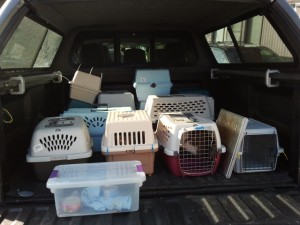
Cats being transported for spay/neuter
For a few years Pamela trapped cats, I drove them into work and fixed them and then drove them back in the evening. It’s been 10 years since I quit my job at the Humane Society, however Pamela’s work has not only continued but she has moved far beyond the occasional two or three cats. She now has an organization that she runs called FCAT (feral cat assistance and trapping) and with volunteer help is able to spay/neuter almost 1000 cats a year. That is a pretty impressive number when you consider that one breeding pair of cats can be responsible for producing over 2000 offspring in four years. Most of these are ferals, however she will help anyone who needs a cat (or in some cases a dog) fixed.
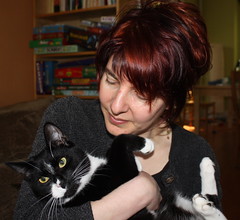
My sweet boy Tug who was born to a feral mom and tamed by Pamela
This is hard work but she feels like this is her mission to help these cats that are forgotten.
Each year in the United States between 3-4 million animals are euthanized in shelters. Many of these are feral cats or the offspring of feral cats. In my shelter work it became clear that pet overpopulation could not be ended until the feral populations could be controlled. Trapping and killing doesn’t work (that is a whole article in itself). People like Pamela are helping to reduce this number every day.

FCAT feral cat holding area
Today we honor Pamela, her dedicated volunteers, and all the people out there making a difference in ending pet overpopulation! Thank you!
For more information about feral cats see
Will you consider making a donation to one of these great groups in honor of Feral Cat Day?
 The good news about squamous cell carcinoma is that it is very slow to metastasize; the bad news is that is locally very aggressive, eating through anything in its path. In addition because this cancer commonly occurs in the mouth, there isn’t a lot of space to easily remove it. While I see more squamous cell carcinoma in cats it also occurs in dogs.
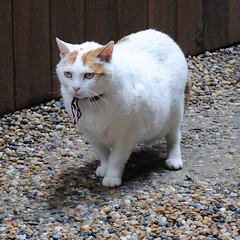
White cats and black dogs
Most squamous cell carcinomas occur in the mouth. However it is also a common cancer on the ears and noses especially of white or light colored cats who go outside in the sun. Another very common spot for squamous cell is in the toes of dogs especially black toed dogs.
Squamous cell often starts with chronic irritation of infection. On the ears of cats it is often from repeated sunburn. In the mouth it is many times secondary to tooth issues and infections.
The prognosis with squamous cell carcinoma is very good if you can remove the whole tumor but unfortunately this is many times not possible. Without removal, the prognosis is pretty poor and these animals experience a lot of pain if it works it way into the bone. However there are therapies that can slow things down and significantly improve quality of life.
I am going to break this article into three sections and talk about squamous cell in toes, in the mouth and then a section on the other places squamous cell can form and a little about cats. Follow the links for more information about herbals and therapies.
Squamous cell on the toes of dogs
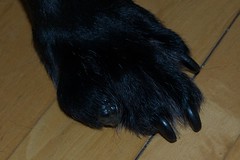 Most squamous cell carcinomas start on the toes as a broken nail or a non-healing infection in the nail bed. Often times a few rounds of antibiotics are prescribed before the cancer is diagnosed. I have only seen squamous cell carcinomas in black furred toes, however it is possible to get the disease in dogs of other colors also.
In some dogs squamous cell causes infection secondary to the cancer and is some animals it is chronic nail bed issues and infections, which cause it to develop.
The treatment of choice is to remove the toe as soon as the diagnosis is made. If the whole tumor can be removed then this is almost always curative.
Many dogs will be done at this point and can live normal lives however I have had some dogs who go on to form multiple cancers in other toes, usually this is because their immune system is not working correctly and also most likely has a genetic component.
 Occasionally surgery is not an option to remove the toe because of poor health or heart conditions and then other treatments need to be used.
I treat a wonderful happy Gordon Setter named Hudson, known to most of those who love him as Huddie. He has lost three toes to this disease and also has Cushings disease, which makes his immune system not as strong as a normal dog.
With Hudson we have developed the following protocol, which I recommend for any dog who has had multiple squamous cell carcinomas in the toes.
So what about the dogs where toe removal is not an option? Here are some options
 So on to Squamous cell carcinoma in the mouths of cats and dogs.
This is a horrible place to get a squamous cell carcinoma. The only way to get a cure is to remove a fourth of the jaw if it is in the lower jaw and there is no such option if it is in the upper jaw. Because this disease is so painful many animals will not eat and that is usually the factor that ends up ending their life. That being said I have seen animals do well for about a year after diagnosis, with integrative treatments. Usually dogs do a little better than cats, who usually don’t make it a year. This really varies animal to animal and involves being able to medicate an animal with a painful mouth.
How can we help these animals with squamous cell in the mouth?
First let me start off by saying in cats I often times just rely on injectable antibiotics, steroids and pain meds plus acupuncture. The amount of pain with oral administration of herbals is not worth any benefit we get from my experience. Occasionally I recommend oral pain meds as well. Below anything oral is mainly for dogs.
Squamous cell other places in the body
Squamous cell can also arise other places in the body. The ear pinnae of white cats are a very common place and also the tip of the nose. Many people will make the decision to remove the ear pinnae and get a cure. For the nose usually a few radiation treatments is curative. Usually squamous cell on the pinnae or nose is slower moving then in the mouth and sometimes if the cat is old the decision will be made to just leave it. When squamous cell occurs other places, surgical removal is the treatment of choice if at all possible. If surgery or radiation is not an option then the treatments above can be used.
 An extra note on cats
In many cats giving more than three drugs or herbs can cause side effects and reduced appetite. Depending on how many western treatments a cat is on usually I only recommend adding in two or three herbals and focusing on diet and acupuncture to supplement their effects.
Some cats cannot tolerate anything going in their mouth if they have cancer there in which case I only treat with acupuncture to try to make them have quality of life while they are here. If only one thing can be given it should be pain medication as this is a very painful disease.
As with all articles on this website please check with your animal companion’s veterinarian before starting any herbals or supplements. This disease more than any other of the cancers I have talked about really needs an integrative approach to treatment involving western drugs and interventions.
Return to Integrative and Holistic Methods for Treating Cancer in Cats and Dogs
 I’m off to my yearly Qi Gong retreat at Karme Choling in the hills of Vermont. I’m looking forward to long days of Qi Gong and good home cooked food.
Qi Gong has been an amazing thing for me. I discovered Eva Wong, my qi gong teacher, when she came to Seattle to teach a weekend workshop about five years ago. At the time I had some major health problems that were making it so I could only work about 20 hours a week. I was exhausted, couldn’t sleep, my digestion was a mess and nothing seemed to be helping. I left that weekend feeling better than I had in a couple years. The more I did Qi Gong the better my health became.
I’ve made sure to do a program with her every year since and my health has greatly benefited. As I have moved through some of the more advanced levels of qi gong and talked to other people who have been practicing this art, I’m heard some amazing stories. There was one woman who was so crippled with rheumatoid arthritis that she could barely walk. After about a year of qi gong she was not only better but the blood tests for this disease were coming back almost normal. She could walk, move her hands again and function like a normal person without pain. Other people with chronic injuries or illness also had seen great improvements in health.
Qi Gong works similarly to acupuncture with the energy or qi that flows through our body. It helps to align and remove blockages in this system of energy. In addition it helps to align the body with the mind. Also see What is Daoist Qigong?
 Eva teaches all over the world. She now has a few other teachers that also teach the style of qi gong she practices. Here is her website if you are interested, Daoist Qi Gong There is a list of places and times qi gong is taught on the website but it is usually incomplete. Eva teaches almost exclusively at Shambhala Centers, to find one near you use this tool Find a shambhala center. You do not have to be a member of shambhala to take her classes. I have found that about half her students are not.
This year John Rockwell, one of her teachers, will be in Seattle to teach the first two levels of qi gong on November 19-20th. If you are interested in attending contact the Seattle Shambhala Center
I’ll be back October 11th and will be out of computer and phone range while I am away. See you then!