Archive for November, 2012

Supporting chemotherapy with anti-oxidants and herbs in dogs and cats

Sunday, November 25th, 2012
If you do a search of Medline, you will not find one study that shows that anti-oxidants or herbs have a negative effect on outcomes of people or animals with cancer who are getting chemotherapy drugs. Even though most oncologists recommend that you do not use anti-oxidants or herbs when an animal is undergoing chemotherapy, there are no studies to support this.

However there are studies that show the opposite. They show longer survival, less toxicity, better quality of life, improved blood work values (such as increases in white and red blood cells) and longer tumor remission with herbal and anti-oxidant treatments.

So why are oncologists so against anti-oxidants and herbs?

These supplements support the body, they keep cells strong, they prevent oxidative stresses, they help with blood flow and blood supply to cells, the very things that chemotherapy doesn’t want when it destroys cancer cells. What many oncologists don’t realize is that cancer cells are very different than normal cells when it comes to natural supplements/herbals.

Cancer cells don’t rely on the things normal cells do. For example many cancer cells live in an oxygen-deprived environment that would kill normal cells yet cancer cells can thrive in such a state. See Oxygen deprivation in cancer cells leads to growth and metastasis. Anti-oxidants don’t appear to protect cancer cells from oxidative stresses. What makes a normal cell strong does not make a cancer cell strong. In fact if we keep the normal cells of the body strong they can help fight the cancer.
With chemotherapy, we are poisoning the body with chemicals that destroy rapidly dividing cells, and cancer cells are very rapidly dividing and reproducing. Unfortunately we also kill off rapidly dividing normal cells such as the lining of the gut and red blood cells and immune system cells (white blood cells). Herbs, supplements and acupuncture can help support normal cells while making it harder for cancer cells to survive. This increases chemotherapy’s effect while decreasing its side effects.

I often use anti-oxidants and herbs with animals undergoing chemotherapy and find that it improves longevity and helps reduce side effects. In addition I love to get these animals on a good acupuncture schedule, as acupuncture is amazing at helping the body during chemotherapy.

Here is a short list of my favorite supplements and herbals to use during chemotherapy. There are many more out there but I think these are the best.

  • First I just have to mention acupuncture – I have had a number of dogs through the years who had to stop chemo because of side effects or low blood cell counts. After one or two acupuncture treatments almost all these dogs were able to continue with chemo. I love that acupuncture is very non-evasive and has many other actions to help animals with cancer. Also see Acupuncture for animals with cancer.
  • Bu Zhong Yi Qi Tang – every dog I treat who is undergoing chemotherapy is on this formula. Click on the name to read more about it. I can’t say enough about this formula. Now available through my etsy store Kingdom of Basil.
  • IP6- Inositol Hexaphosphate also known as IP6 is important in stimulating the immune system’s natural killer cells to destroy cancer tissue. It is an antioxidant and has effects in inhibiting cancer cell growth and division. Not much research has been done in humans with this supplement but a lot of cancer studies have been done in animals. IP6 has been shown to enhance chemotherapy’s effect. IP6 can be bought off Amazon.com or at your local supplement store.
    I dose cats at 400mg two times a day and dogs 800-1600mg twice a day when I use this supplement.
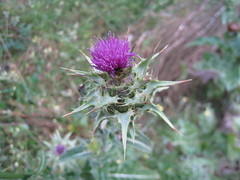
  • Milk Thistle – prevents oxidative damage to normal cells and helps to support the liver in detoxification of chemotherapy drugs. There are studies that show that Milk Thistle not only protects normal cells but also enhances the outcomes of chemotherapy drugs, i.e. it helps them work better and kill cancer cells more effectively. See National Cancer Institute’s Page on Milk Thistle and Sloan Kettering Cancer Center article on Milk Thistle.
  • Coenzyme Q10 – prevents cardio toxicity of doxorubicin without reducing its effectiveness. In addition it is a good anti-oxidant, stimulates the immune system and has its own anti-cancer activities. I almost always use this supplement with doxorubicin. I dose Coenzyme Q10 at 200mg per day for dogs and 50mg per day for cats. Coenzyme Q10 can be buy off of Amazon.com or at your local supplement or natural food store.
  • Medical mushrooms such as shitake, maitake, reishi, turkey tail and/or cordyceps help to enhance the immune system and have strong anti-cancer activity. There are many good products out there. I like the MUSH mushroom blend for pets. If you are cooking up mushrooms as part of a homemade diet check out Fungusamongus. Human mushrooms supplements can also be given. I recommend at least 500mg of mushrooms be given daily for every 50lb of cat or dog. More is fine.
  • Fish Oil supplements – help with cancer cachexia and weight loss and help to support the body through anti-oxidant activity. I like the Nordic Naturals – Pet Cod Liver Oil.
  • Food therapy – add in anti-oxidants such as berries, green veggies and sweet potato which are high in vitamin A, medical mushrooms with anti-cancer properties and liver which is high in vit A and iron. See Diets for cancer in cats and dogs – you are what you eat a fighting cancer machine.
  • Work with herbals that fight against cancer so that it is not just the chemotherapy at work. I often include artemisinin, Xiao Chai Hu Tang or Xue Fu Zhu Yu Tang in my protocol for animals getting chemotherapy. I rarely if ever use something very strong which can be toxic like Hoxsey with chemotherapy, although will use it after chemotherapy is over if it fits the cancer. If I am working with a cancer where Hoxsey is a good fit I often use Si Miao San. Use what fits your animal best. This is a very good place to get your holistic vet on board.
As with all articles on this blog please check with your animal’s veterinarian before adding any supplements or herbals.

Back to Integrative and holistic methods for treating cancer in dogs and cats
Above all quality of life – treating terminal disease in dogs and cats

Tuesday, November 20th, 2012

The nature of loving our animal companions is that at one point they will leave us. We are blessed with their presence in our lives but they are not blessed with long life like us humans.

Knowing that our animal companions will most likely die while we are still living, means that there will be something that takes them, whether cancer or old age or other diseases.

This does not mean we do not try our best to support them in illness or to treat the diseases that come along that we can. We are given medicine for a reason.

What it does mean is sometimes we need to reach a point of acceptance and do what we must out of love for them and not because we cannot bear to be on this earth without them.

True love sometimes means letting our loved ones die with dignity. It means not doing treatments that cause suffering if there is little hope attached to them.

With cats who live to be independent this is most clear. They often reach a point where they do not want intervention. With dogs who live to please us the line is often blurred.

So what does this mean?

If your dog loves the pizza crusts more than anything in the world and you want to put them on a grain free diet for cancer, allow an occasional pizza crust

If chemotherapy is making your dog or cat sick over and over again unless the good it is doing outweighs the odds it may not be worth continuing.

If you cat is already twenty years old, doing an invasive surgery may not be the best option.

If you can’t afford to pay for treatments without working a second job, think about if the time away from your animal companion is worth it.

If your dog hates acupuncture and shakes in the waiting room, it may be kinder to let them live out their last days at home.

If your cat runs from you every time you give meds, are they really worth giving (I make an exception to pain meds in a painful animal here).

Use your wisdom, find help from either local or online support groups and/or your veterinarian in helping make a decision of what is too much and what is most helpful.

Be kind to yourself, there is not just one right decision.

Do not give up hope but also do not allow suffering. Lead with your heart and your love.

Back to Integrative and Holistic Methods of Cancer Care

Arthritis and your dog and cat – holistic options

Monday, November 19th, 2012

It’s sad to see our animal companions no longer be able to do the things they once could do as they age and grow older. All older animals have some amount of arthritis although some have many more problems with it.

Unfortunately, Western medicine has very few options for treating arthritis and uses mostly drugs, to cover the pain. Some animals are not able to tolerate these drugs and many times animals are on three different drugs and it still isn’t enough.

In some animals arthritis manifests as weakness caused by the inflammation pushes on the nerves. Many dogs walk around like their feet are asleep, tripping over things, stumbling and no longer having the strength to jump into the car or onto the bed. Unfortunately because they can no longer walk as far or do as much as they used to, their muscles start to atrophy or waste away, causing a vicious cycle. As the weakness increased, they do less, which causes more atrophy from disuse, leading to more weakness and more atrophy and less activity. In the end many of these animals can no longer get up on their own or even take a short walk.

In other animals arthritis will manifest as pain, which can also prevent movement and cause the weakness/atrophy cycle. Many of these animals will become moody and withdrawn and may even snap and bite at their people out of fear of pain. It is so hard to see our friends have so much pain that they no longer want our affection.

In most animals there is a combination of pain and weakness.

Usually dogs suffer more than cats because they carry more weight and are used to daily activity. Also people often don’t notice that their cats are painful because they spend so much time sitting and sleeping

So what do we do for our friends to help them live out their old years happy and pain free?

  • Acupuncture Being an acupuncturist, I always recommend acupuncture first. Of course this is also because I have seen how well it works in the animals I treat. I often find that if I can work with animals when they first have problems, they do so well we only need to treat them every one to three months. Unfortunately most of the animals I see have had problems for a while and their people only learned about acupuncture when they had tried everything that western medicine had to offer. In these animals acupuncture can still work and work well but usually treatments need to be closer together.

    It is so nice to see these animals happy and able to enjoy life again!

  • Hydrotherapy is a great option especially in dogs who have muscle atrophy. Unfortunately it cannot be done with cats although Sheila Wells at Wellspings has told me they have worked with rabbits before. Hydrotherapy is done in a small swimming pool and involves massage and physical therapy in the water. I have seen excellent results with hydrotherapy especially combined with acupuncture. Hydrotherapy helps to rebuild muscles, increase range of motion and work out sore and sensitive areas of the body without the impact on the body of exercise on land. My favorite pool is Wellsprings in Seattle Washington. They have a great website with lots of information and photos that I love to refer people to. Click on the link to check it out!
  • herbs5

  • Herbs
    I have worked with Chinese herbs with many of these arthritic dogs and some cats. The combination of acupuncture and herbs usually helps with pain and movement and helps animals maintain between treatments. Some animals do not do well on Chinese herbs and it is important to work with an herbal practitioner to find the right combination to help your particular animals. I rarely use Chinese herbs in cats because they hate to be medicated and will not often eat herbs in food. I sell an old dog herbal formula called Old Dog Winter Support through my etsy shop that helps with arthritis pain and improves blood circulation into the joints. There are also commercial products available, my favorite is DGP (Dog Gone Pain).
  • Fish oil/ Omega oils
    The Omega 3 Fatty Acids in fish and cod liver oil actually helps decrease arthritic inflammation in dogs (not true for cats although it helps with other things). Adding a little fish oil to the diet can help many animals.My favorite brand is Nordic Naturals – Pet Cod Liver Oil . Nordic Naturals is one of the best brands for quality and they test for heavy metals and contaminants.
  • Glucosamine/MSM/chondroitin
    These supplements help to decrease inflammation and rebuild damaged cartilage. They are often sold in combination. The nice thing about these supplements is that they have few side effects and are very safe. Some animals have a wonderful response to them and some have almost no response. It usually takes a month to six weeks to see if your animal will have a positive response. Adequan, similar to glucosamine is also available in an injectable form and works better in some animals. It is also a lot easier to give to cats who are hard to medicate daily. After the initial series of injections it usually only needs to be given once a month. My favorite is Sea Mobility Beef Joint Rescue jerk treats, they work well and are very tasty.
  • Infra-red light therapy – Infrared light helps ease the pain of arthritis in joints and increase blood circulation to the area. It is very cheap to do and can be done at home. See my article Infrared Light Therapy for kidney failure, incontinence and arthritis.
  • Chiropractics
    Many animals have subluxations of their spine especially as they age. A good chiropractor can often help with mobility and pain. I have found that chiropractic adjustments work best in animals with a very tight back and more pain then weakness. For my own cat, chiropractic adjustments have worked better than anything else we have tried and have made his life much better. Make sure you find a chiropractor who is used to working with animals and knows animal anatomy.
  • Massage/Acupressure
    Massage can help to loosen tight muscles and increase blood circulation. It also can help with pain.We know it works for us, why not for our animal friends. Once again make sure you find a massage practitioner who is certified to work with animals.

    Acupressure works with the acupuncture points and helps decrease pain and relax muscles.

    There are many great books on acupressure and massage for animals. Here are a few
    The Well-Connected Dog: A Guide to Canine Acupressure
    Acu-Cat: A Guide to Feline Acupressure
    The Healing Touch for Dogs: The Proven Massage Program for Dogs, Revised Edition
    The Healing Touch for Cats: The Proven Massage Program for Cats, Revised Edition
    Four Paws Five Directions: A Guide to Chinese Medicine for Cats and Dogs

  • Reiki/Bowen/Polarity/Craniosacral and other energy therapies These therapies help stimulate the body to heal and can decrease pain and improve quality of life. Since there is little regulation of these therapies it is important to get a referral before seeing someone. This is especially true of Reiki since there are so many people who practice it. A good practitioner can make a huge difference in an animal’s quality of life.

It is better to do one thing and stick with it than to jump around between therapies. Often times animals will began with me doing acupuncture and herbs and then we will add in other therapies as needed. If I can’t help an animal with acupuncture I will refer them to another practitioner to try something else. Don’t make too many changes all at once in an old animal’s life. Go slowly instead.

New study out on using Turkey Tail mushroom extract for hemangiosarcoma in dogs

Friday, November 9th, 2012

Exciting news this week!

The University of Pennsylvania Veterinary School just released a study showing that the Turkey Tail mushroom extract, PSP, significantly increased survival of dogs with hemangiosarcoma. Compound Derived Mushroom Lengthens Survival Time in Dogs with Cancer.

This study showed that at a very high dose of this compound (100mg/kg/day), average survival in dogs with hemangiosarcoma was 199 days. This is about twice the survival of doing nothing and better than any chemotherapy survival times that I have seen.

However I am cautiously optimistic. This study was funded by the herbal company, Imyunity that makes this very expensive compound. While I know that most studies are funded by drug/compound companies, I always hesitate when viewing the results because I believe the results can be biased.

I also wonder if these studies are reproducible with other cheaper PSP compounds like this one Coriolus-PSP or with whole turkey tail mushrooms.

At this point I am excited to add Turkey Tail into my existing protocol and see what happens. I see no down side beyond cost and I do plan to use the cheaper supplements.

I have a lot of faith in Steve Marsden’s protocol that I have started using and am excited to see if the addition of Turkey Tail helps some of these dogs even more. See The hardest cancer – how to treat hemangiosarcoma in Dogs.

If you are wanting to work with it yourself, the recommended dose would be about 2.4g per 50lb of dog or 6 400mg capsules a day.

Here is a good company if you want to work with the whole mushroom. Mushroom Harvest sells Turkey Tail in both capsules and powder form.

What I made today – Long Dan Xie Gan Tang (Gentian Drain Liver Formula) for seizures and skin/eyes

Sunday, November 4th, 2012

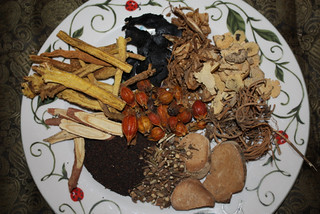
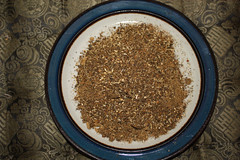
This formula is a good one coming into Thanksgiving. To me the herbs in it look like a Thanksgiving feast. Long Dan Xie Gan Tang (Xie is pronounced like Shay) is a great formula for draining fire out of the head. One of its most common uses is for treatment of excess seizures.

Other uses are for extreme itch up in the head, and many of the eye disorders such as glaucoma, pannus, and uveitis. Note – glaucoma is a serious condition and should be treated with western medicine as well. It can also treat infections in the head however if there is a potential or proven bacterial infection antibiotics should be considered and used in most cases.

His formula treats yang liver fire flaring. In Chinese medicine seizures are often caused by fire wind flaring up into the head with phlegm obstruction of the head where it can not exit. This formula anchors yang, drains heat out of the liver and heart, treats phlegm, and supports the yin that controls yang. Animals needing this formula tend to run hot, they may be agitated, anxious or have aggression issue. For seizures this is a formula to treat the more violent grand mals. You would not use this for very mild seizures or for older animals who are very debilitated. Animals needing this formula may have a very red or purple red tongue and may be thirst.

While this formula is most often used for animals with excess conditions (not the very weak or debilitated) I have used it in older or weak animals when combined with other formulas or modified.

My own older cat is a good example of an animal with some deficiency who has done well on this formula. She is currently on this formula for sinus and eye inflammation with extreme itch to her head. She was at the point of scratching so hard that she was in danger of injuring her eyes and was making her head bleed. The itch is about 90% better since I started Long Dan Xie Gan Tang. In western medicine a steroid shot would be in order but with her early kidney issues this would be a bad idea, as steroids are very hard on the kidneys. Because this formula contains a large amount of rehmannia it helps to support her kidneys while taking care of the itch.

So what is in this formula –

  • Sheng Di Huang (rehmannia)
  • Dang Gui (Chinese angelica root)
  • Long Dan Cao (gentian root)
  • Ze Xie (alisma tuber)
  • Mu Tong (akemia)
  • Chai Hu (bupleurum root)
  • Che Qian Zi (plantian seed)
  • Gan Cao (licorice root)
  • Huang Qin (scutellaria root)
  • Zhi Zi (gardenia fruit)

This formula can be very draining and drying. The Sheng Di Huang helps to support the yin and blood and keep this formula from drying out the body. Dang Gui prevents stasis in the body and also supports the blood.

Long Dan Cao, Huang Qin and Zhi Zi drain fire out of the upper body. Huang Qin also known as Skullcap is also often used in western herbal medicine for seizures and to calm anxiety. Long Dan Cao or gentian root is used as a digestive tonic or bitter in western herbology. All these herbals also have some anti-bacterial properties, especially the yellow root of Huang Qin.

Che Qian Zi because it is a seed helps to sink the yang back into the body. Mu Tong, Ze Xie and Che Qian Zi help to drain dampness or treat phlegm.

Gan Cao harmonizes the formula and prevents side effects, while supporting the digestive system.

Chai Hu helps to get this cool formula to work in a hot animal. Paired with Huang Qin it also helps to treat triple burner obstruction and get energy flowing properly in the center of the body so that you don’t have excess yang up in the head. Chai Hu can also help with anxiety and agitation.

I often use this formula along with western seizure drugs. It helps to support the liver which is helpful as many seizure drugs are very hard on the liver.

While this formula has the potential to cause diarrhea, in the form I use with the large amounts of sheng di huang I have not seen any issues. If your cat or dog is prone to diarrhea it may not be the one to use or may need to be combined with other formulas.

Available in my etsy store, Kingdom of Basil.